
I imposed tariffs on India to take action against Russia', Trump gets angry over question about Putin
'I imposed tariffs on India to take action against Russia', Trump fumed on question about Putin 1 - image

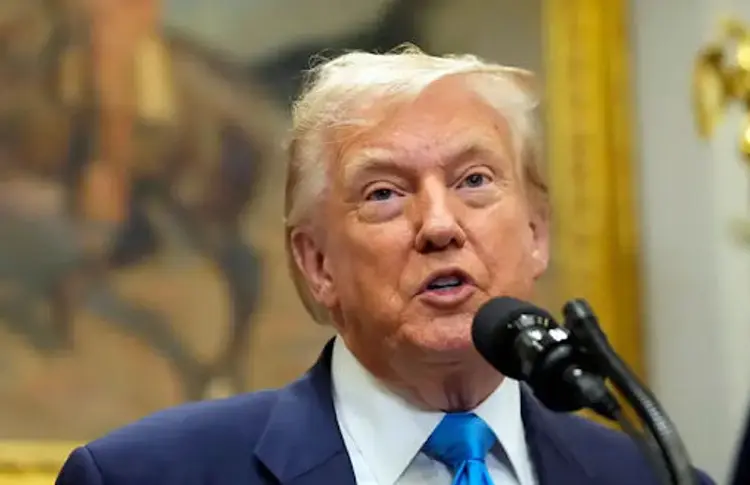
Oval Office Donald Trump Statement: US President Donald Trump has been targeting India for some time now. On Wednesday (September 3), Trump said, "I have imposed initial sanctions on India for buying Russian crude oil and have indicated that more sanctions may be imposed in the future." Trump's statement came during a bilateral meeting with Polish President Karol Nawrocki in the Oval Office. When a Polish journalist asked him about not taking any action despite expressing displeasure with Russian President Vladimir Putin, Trump looked angry.

Donald Trump answered a journalist's question in response to a journalist's question, US President Donald Trump said, 'How do you know that no action has been taken? Are you saying that it is equivalent to imposing secondary sanctions on India, the largest buyer outside of China? Are you saying that no action has been taken? This has cost Russia billions of dollars. You wouldn't call this no action? And I haven't completed the second or third phase yet. But when you say that no action has been taken, I think you should look for another job.'

Comments

Popular posts from this blog

India strongly condemned Trump's advisor Peter's 'Brahmin' comment, saying...

The Ministry of External Affairs (MEA) has strongly condemned the recent statements made by White House Trade Adviser Peter Navarro, terming them as false and misleading. Addressing a press conference, External Affairs Ministry spokesperson Randhir Jaiswal said that we have seen the false and misleading statements made by Peter Navarro and we reject them. Earlier, while defending US President Donald Trump's 50% tariff, Peter Navarro had made a controversial allegation that 'Brahmins' were profiting at the expense of the Indian people. On this, a spokesperson for the Ministry of External Affairs said that India-US relations are very important to the government. Randhir Jaiswal told the press conference that the India-US relationship is very important. This comprehensive global strategic partnership is based on shared interests, democratic values, and strong people-to-people ties. He said that despite challenges and changes, this partnership has remained strong and both count...

Will Trump come to India for the Quad summit? Amid tariff dispute, India-US relations may see a new beginning

India-US Relations :   Tensions are currently running high between India and the US and between President Donald Trump and Indian Prime Minister Narendra Modi, but will the friendship between the two leaders get back on track? This question has become the center of discussion in global diplomacy. Despite trade tensions and 50% tariffs between India and the US, an opportunity to strengthen relations between the two countries can be found in the Quad (Quadrilateral Security Dialogue) summit. India is going to host this summit in November this year. Trump recently took to his social media platform Truth Social to describe the India-US trade relationship as a one-sided disaster and imposed a total of 50% tariffs on India, including an additional 25% tariff on its purchase of Russian oil. He also claimed that India had offered to reduce the tariffs to zero, but it was too late. On the other hand, India has called the tariffs unfair, unexpected and unreasonable. However, PM Modi did...

Japanese Prime Minister resigns: This is why he took a big decision

Japanese Prime Minister Shigeru Ishiba resigned on Sunday. Ishiba has taken this step to avoid a split in the ruling Liberal Democratic Party (LDP), Japanese media NHK reported this news. Ishiba's coalition government lost the upper house (House of Councilors) election held in July. Ishiba recently apologized for this and said that he would decide to resign. After the election defeat, the 'remove Ishiba' movement intensified within the LDP. Some party leaders and lawmakers questioned his leadership, which weakened his position. Now, after his removal, the race for a new leadership in the LDP will begin. Ishiba's Liberal Democratic Party (LDP) and its allies lost their majority in the country's upper house in elections held in July. However, at the time, he said he would not resign as prime minister. There are a total of 248 seats in the upper house of the Japanese parliament. Ishiba's coalition already had 75 seats. He needed at least 50 new seats in this elect...